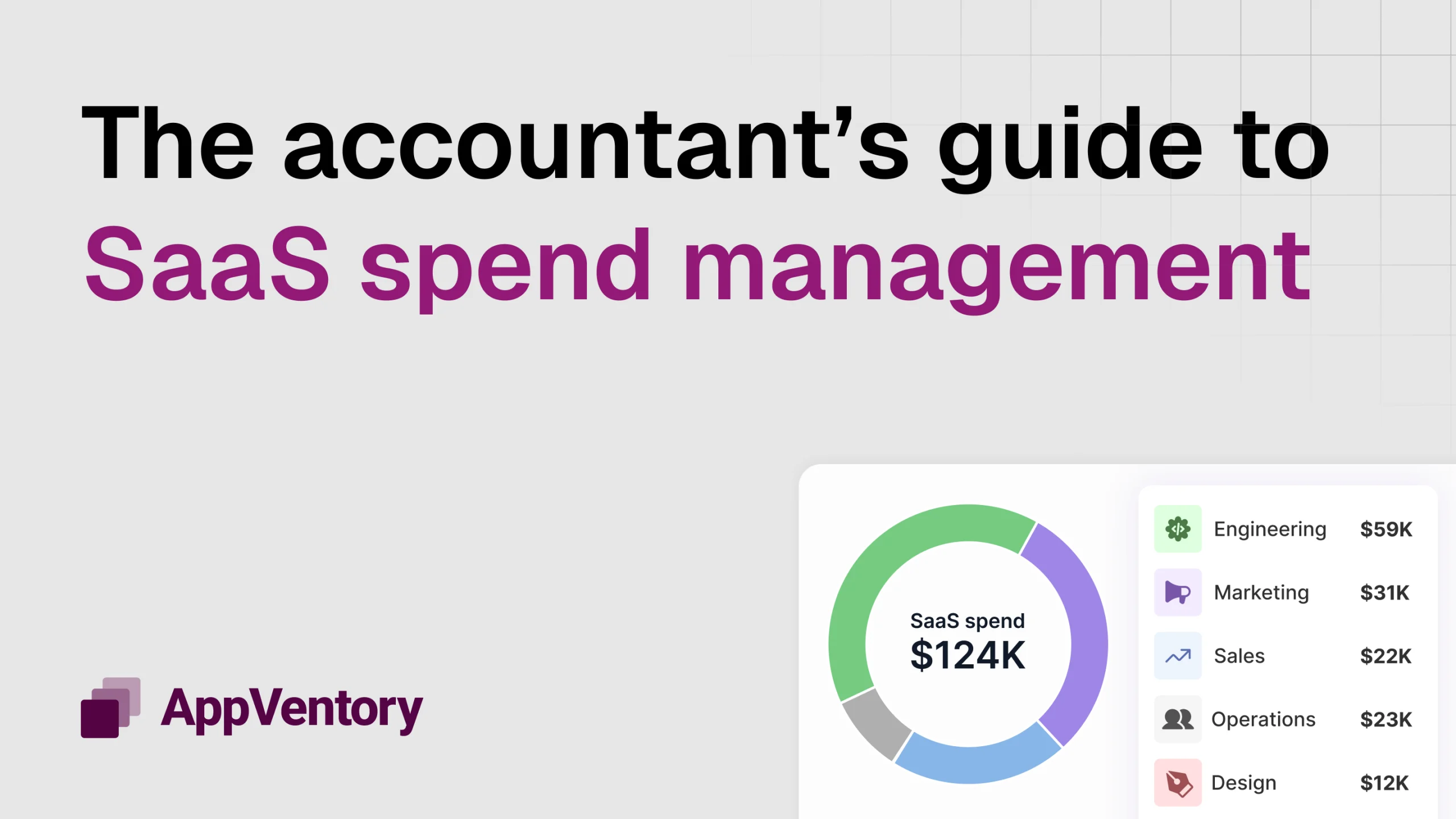
Every one of your clients is quietly overspending on software — and the evidence is already passing through your hands. The seats nobody uses. The two apps that do the same job. The AI subscription a manager expensed on a company card and forgot. It adds up, it renews automatically, and every dollar of it flows through the ledger you reconcile every month. The one person positioned to see the whole picture isn’t the client’s IT guy or a dashboard vendor. It’s their accountant.
That’s you.
That’s the short version of why SaaS spend management has become one of the most natural advisory lines an accounting or bookkeeping firm can offer — and why the firms that move on it first are turning a problem their clients can’t see into a service they’re happy to pay for. This guide covers what the term actually means, why the timing favours accountants specifically, and how the pieces fit together into something billable.
What SaaS spend management actually means
SaaS spend management is the practice of tracking, controlling, and optimising everything a business pays for in software and AI subscriptions. It brings every tool, contract, renewal date, and usage signal into one view, so that duplicate apps, unused licences, and quietly rising costs become visible instead of buried across a dozen invoices and a dozen credit-card lines.
Strip away the jargon and it’s three questions any business owner would want answered:
Are we paying a fair price? Renewals arrive, auto-renew at last year’s terms plus an increase, and nobody negotiates because nobody’s watching the calendar.
What are we actually paying for? Most companies genuinely don’t know. Software gets bought by whoever needs it — marketing signs up for one tool, sales for another, an intern starts a free trial that converts to a paid plan three weeks later. There’s rarely a single list.
Are we using what we pay for? Licences get bought for a headcount the company no longer has. People leave; their seats don’t. Whole tools get adopted with enthusiasm and abandoned within a quarter, still billing monthly.
Answering those three questions, consistently and with data, is the whole discipline. Everything else — the dashboards, the alerts, the reports — exists to make those answers easy to produce.
It helps to place it. Spend management is the cost-and-optimisation slice of a wider discipline usually called SaaS management — the whole job of governing a software stack, which also covers security, access, and offboarding. Alongside it sits software licence management, the seat-and-contract side. This piece stays on the money: what a business pays, what it wastes, and what it can recover. For an accountant’s purposes that framing is the useful one — it’s spend, it shows up in the books you already touch, and right now it’s going unmanaged.
How much are businesses spending on software and AI in 2026?
For years, software was a rounding error on most SMB P&Ls — a few tools, a predictable bill. That era is over, and the analyst data makes the shift hard to argue with.
Gartner forecasts worldwide software spending will reach roughly $1.44 trillion in 2026.
Gartner forecasts worldwide software spending will reach roughly $1.44 trillion in 2026, growing about 15% year over year — one of the fastest-growing lines in all of IT. The steepest curve inside that is AI: Gartner projects spending on generative-AI models to grow around 80% in 2026, and notes that AI features are now embedded across software businesses already own, pushing the cost of tools they’ve had for years quietly upward.
What that macro picture looks like inside a single client is a stack that nobody fully owns. Independent research consistently finds that a large share of paid software licences — often close to half — sit unused, and that a meaningful slice of a company’s apps were never sanctioned by anyone in finance at all.
The money doesn’t disappear in one dramatic line item. It leaks — a seat here, a duplicate there, an auto-renewal nobody flagged. Individually trivial, collectively material.
Business owners find it hard to track all expenses across software and AI tools.
For the business owner, this is invisible. They see a working set of tools and a manageable-looking set of charges. They do not see the aggregate, because seeing the aggregate requires pulling every subscription into one place and reading it against actual usage — which is precisely the kind of work a business owner never has time to do.
But it’s exactly the kind of work an accountant is built for.
Why software spend management is an accountant’s job, not IT’s
The instinct is to file software spend under “IT problem.” For a large enterprise with a procurement team and a CIO, fair enough. For the small and mid-sized businesses most firms serve, there is no IT department — there’s an owner, a bookkeeper, and an accountant. And of those three, only one already has the data, the trust, and the cadence to do something about it.
Consider what you already have that IT platforms don’t:
- You have the ledger. Every subscription a client pays for eventually passes through the books you reconcile. You’re already looking at the raw material of a spend review — you’ve just never been asked to read it as one.
- You have the relationship. Software spend is a sensitive conversation — it touches budgets, decisions, and sometimes egos. Clients take that conversation from the advisor they already trust with their numbers, not from a dashboard vendor cold-emailing them.
- You have the rhythm. Advisory works because it’s recurring. You already meet clients monthly or quarterly. A software spend review isn’t a new relationship to build; it’s a new agenda item in a meeting that’s already on the calendar.
And the timing lines up with where the profession is already heading. Client advisory services (CAS) have been the fastest-growing area in public accounting for several years running. The AICPA and CPA.com’s benchmark survey has repeatedly put CAS growth in the mid-teens — well ahead of the profession overall — precisely because advisory is priced on the value delivered rather than the hour spent, and produces recurring revenue instead of seasonal spikes. Software spend advisory fits that model exactly: it’s outcome-priced (you’re paid for the savings and the oversight, not the timesheet), it’s recurring (spend doesn’t manage itself once and stay managed), and it deepens the relationship every time you run it.
The compliance work that used to anchor firms is being automated and commoditised. The advisory work replacing it rewards firms that can turn data they already hold into decisions clients can’t make on their own. Software spend is one of the clearest examples of that shift sitting in plain sight.
What a software spend advisory service includes
“Manage client software spend” is a goal, not a service. In practice it breaks into a handful of concrete, repeatable deliverables — each one billable on its own, each one building on the last.
A spend assessment: The starting point: pull every software and AI subscription a client pays for into one view, flag the unused licences and the overlapping tools, and put a number on the recoverable spend.
Picture a 40-person agency. It’s paying for 55 project-management seats because nobody removed the ones tied to people who left. It’s running both Zoom and Teams because two departments each picked their own. And it’s auto-renewing a $12,000 analytics contract a team stopped opening eight months ago. None of those lines looks alarming on its own invoice — but pulled into one view, they’re the difference between a vague sense that “software costs a lot” and a specific, recoverable number. Delivered as a report, that’s a client’s first “I had no idea” moment — and your first invoice.
A renewal calendar: Most overspend is locked in at renewal, when a contract auto-renews on unfavourable terms because nobody was watching. SaaS renewal management — knowing what’s coming up 90, 60, and 30 days out, and walking into each one prepared — turns a missed deadline into a negotiation. It’s low-effort to run, and clients feel the value the first time you save them from a renewal they’d have rubber-stamped.
A flag on what the review surfaces: Mapping the spend has a useful side effect: the same pass that finds unused seats also turns up apps nobody sanctioned — each one a subscription the client is paying for, and a place their data now lives. You’re not running a security audit; you’re noting what fell out of the money exercise. (Governing that stack properly — access, offboarding, shadow IT — is its own broader discipline, and a natural next conversation.)
Ongoing oversight: The assessment is the one-off; the oversight is the retainer. Once the stack is visible, keeping it visible — catching new subscriptions as they appear, flagging seats as people leave, watching the renewals — is the recurring engagement that makes this a service line rather than a project.
Some firms take it a step further and on-charge the software itself, becoming the channel through which clients buy and manage their tools, and earning margin on the spend they’re already overseeing. That’s the advanced move — but it starts with the same first step: making the spend visible.
You don’t need to build all of this at once, and you don’t need to become a software expert to do it. The point is that “SaaS spend management” isn’t one intimidating new competency. It’s a ladder of small, concrete services, each of which starts from data you already have.
How to start offering software spend advisory
If this is landing, the honest next question isn’t “should we offer this” — it’s “how do we actually run one.” The lowest-risk way to find out is to run a single spend review for one existing client: pull their subscriptions into one view, find what’s unused or duplicated, and put the recoverable number in front of them. It’s the fastest way to see both the value to the client and the shape of the service for your firm.
We’ve written a step-by-step walkthrough of exactly that process — from pulling the data out of the accounting platform to presenting the findings — in How to run a client software spend review.
The broader point is the one worth sitting with: your clients’ software spend is growing, largely unmanaged, and visible to almost no one who’s equipped to act on it. You’re already in the books. You already have the meeting. The only thing missing is reading the spend as the advisory opportunity it already is.
AppVentory gives accounting and bookkeeping firms one place to see every client’s software and AI spend — surfacing savings, tracking renewals, and turning the whole thing into a billable advisory service. See how it works.