You’ve decided a software and AI advisory line is worth adding to your practice. Good — it’s one of the most lucrative lines you can run. But two questions stall most firms before they start: how do I scope it, and what do I charge?
Here’s a straight answer to both.
Scope It Around Four Outcomes
Clients don’t buy “software audits.” They buy outcomes. Scope the service — and explain it — around four:
- A new advisory service line. You turn the software and AI spend already sitting in their books into something managed and optimised. This is the value; everything else is how you deliver it.
- Compliance & Security. You keep their business protected as software and AI risk grows — clean inventory, access control, and flags where the stack falls short of their regulations.
- Stack Standardisation & Digitalisation. You spot the ten overlapping tools doing one job, standardise them, and lead less tech-savvy clients through genuine modernisation.
- Recharge. You manage app recharging cleanly, turning a messy manual reconciliation into a managed part of the service.
That’s the scope of work a client is actually paying for. Now the price.
Price It in Two Stages
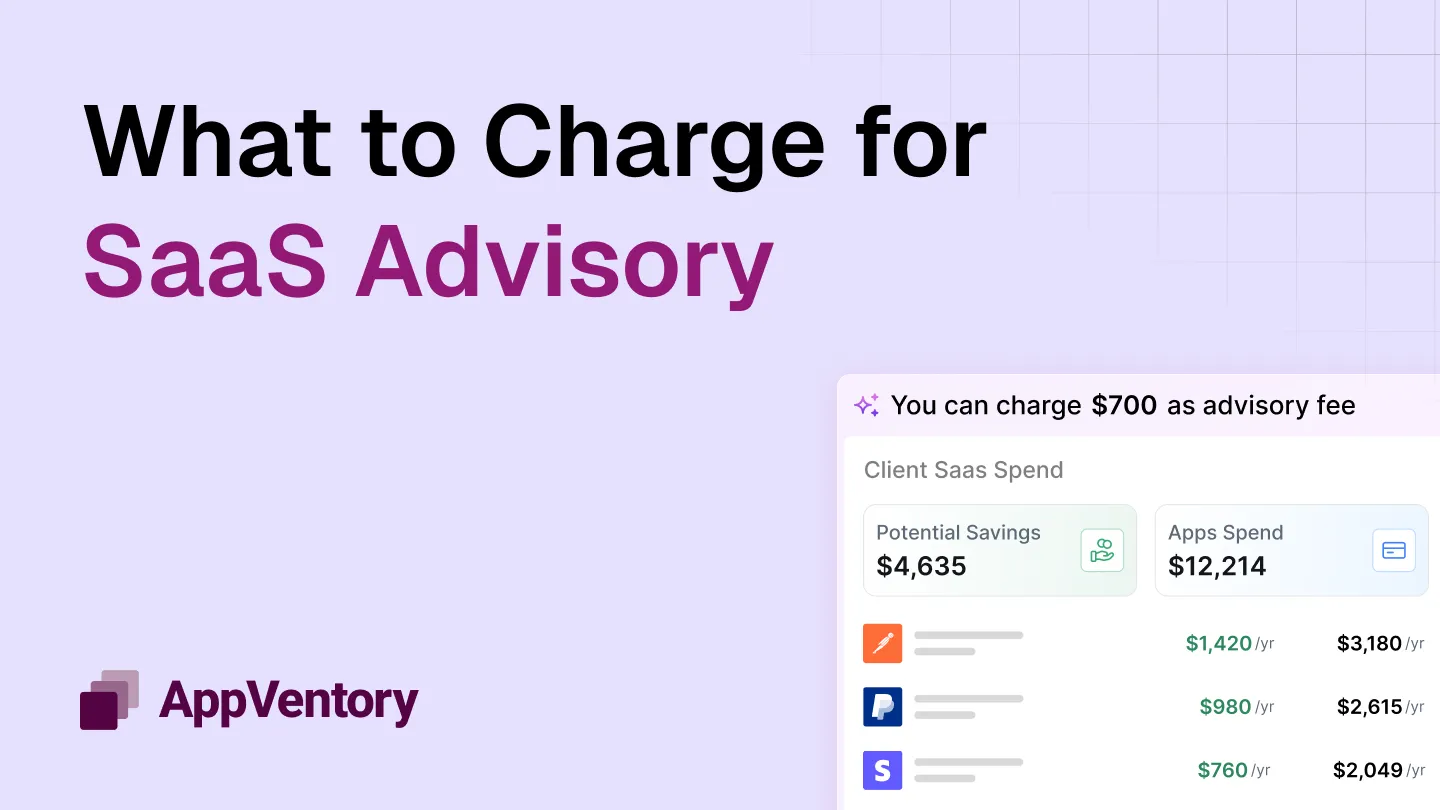
Stage one: a discovery engagement. A one-time fee to map the full stack, quantify current spend, and deliver a findings report. It’s low-risk for the client, almost always pays for itself in what it surfaces, and gives you the data to scope the retainer. Think of it as the paid pilot that earns the ongoing relationship.
Stage two: the monthly retainer. This is where the practice compounds. Price it one of three ways, depending on what your clients respond to:
- Percentage of spend under management — you charge a percentage of the total software and AI spend you’re monitoring. Scales naturally as their stack grows.
- Flat tier by stack size — simple, predictable bands based on how many tools or clients are in scope. Easiest to quote and explain.
- Share of realised savings — you take a cut of what you actually save them. Highest-trust, easiest first “yes,” because the client only pays out of money you found.
The discovery project is a one-off. The retainer is the practice. That recurring line is the entire point.
The First-Client Script
You don’t need a pitch deck. You need one clear conversation with a client who already trusts you:
“Software and AI is becoming one of your biggest line items, and it’s only growing. I can build you a service that keeps it under control, keeps you compliant, and standardises what your team actually uses. Let me start with a one-time review — I’ll map your full stack, show you exactly what you’re spending and where the waste is, and from there we set up ongoing management. The review pays for itself, and you’ll see the number before you commit to anything more.”
That’s it. The number you surface in the discovery review is your entire sales pitch for the retainer. Once a client sees it, the ongoing service sells itself.
Why This Doesn’t Take a New Hire
Here’s the objection worth answering head-on: doesn’t a new service line mean new people?
It used to. Logging into every vendor portal, chasing renewals, reconciling licences by hand is hours per client per month. That’s what made this uneconomical to offer.
Not anymore. You connect your systems and an advisor agent does the monitoring — inventory, renewals, unused licences, compliance, savings — so your team spends its time on the advice, not the admin. Setup takes under an hour. From there, roughly an hour a month generates the service line.
That’s the shift: the busywork is automated, so the margin is yours.
See It on a Real Client
The fastest way to know what you could charge is to run the numbers on one of your own clients.
Book a 30-minute demo and we’ll show you how AppVentory maps a client’s full software and AI spend, surfaces the savings, and turns it into a client-ready deliverable with your practice’s name on it — set up in under an hour.
You already have the clients. This is the service line that fits inside them.