
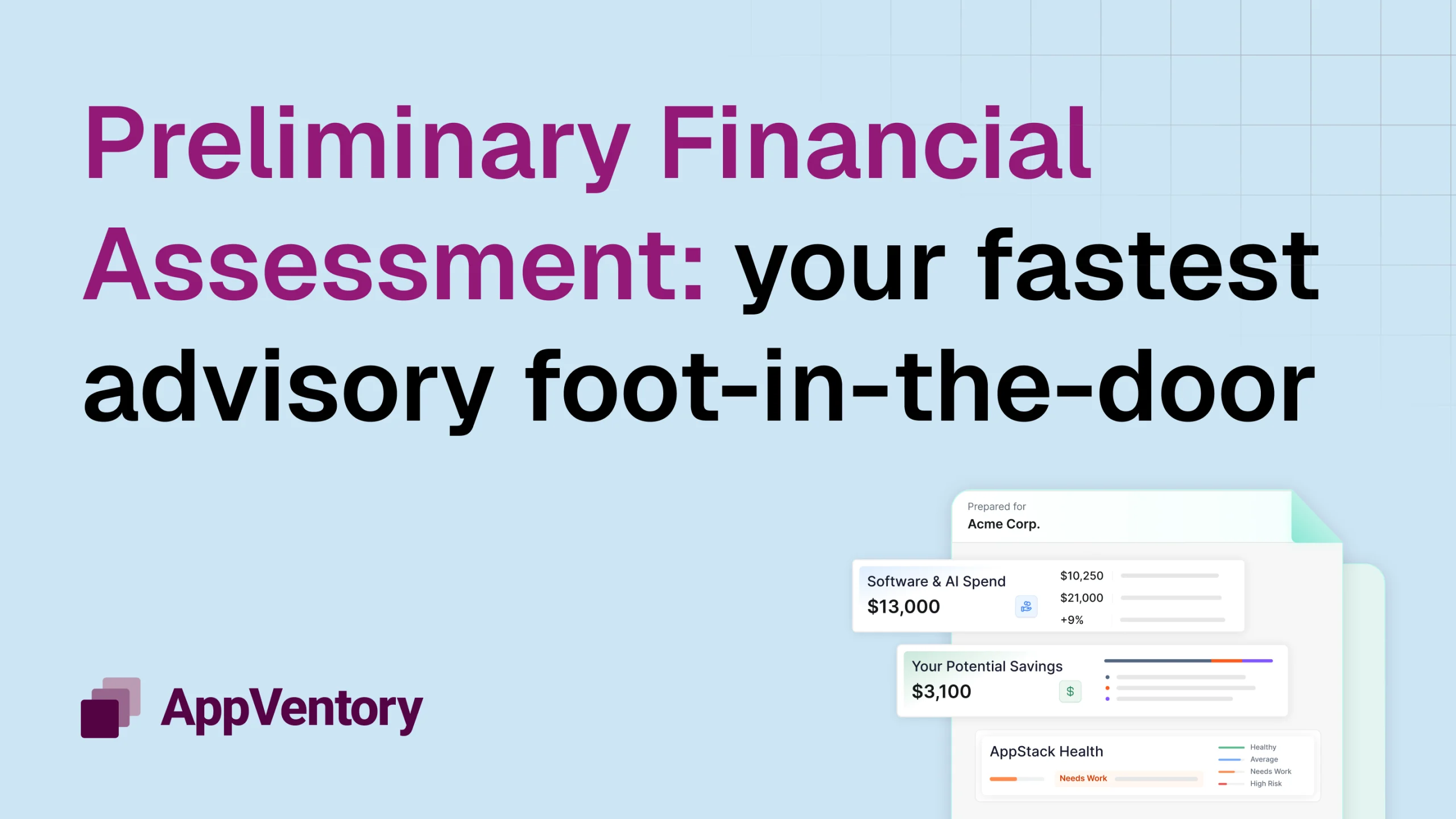
You’ve got a client who’s been “meaning to talk about advisory work” for two quarters running. They trust you with compliance. They just haven’t seen a reason to pay you for anything more — because you’ve never shown up with something that made the case for you. A preliminary financial assessment is that something: a fast, low-lift engagement that puts real findings in front of a client before you’ve asked for a bigger commitment.
Why the advisory pitch stalls before it starts
Most advisory conversations die at the scoping stage. You know the client has waste in their software stack, duplicate tools, seats nobody’s using, a renewal that’s about to auto-charge — but proving it means hours of manual digging through invoices, login lists, and spreadsheets you’re not billing for. So the pitch stays a pitch. “We should talk about your tech stack sometime” isn’t an offer, it’s a maybe, and clients don’t act on maybes.
Meanwhile the client isn’t thinking about you as anyone but the person who files their returns. Compliance work is invisible by design — when it’s done right, nothing happens. That’s hard to build a growth story on. What clients remember is the moment someone showed them a number they didn’t know: money leaking, a renewal they’d forgotten, a tool three people stopped using in March. That moment is the entire pitch. Right now, most firms can’t produce it without a week of unpaid prep work.
Why this keeps happening
The real blocker isn’t willingness — it’s tooling. A proper spend review means pulling data from accounting software, identity platforms, and however many SaaS tools the client has quietly accumulated, then reconciling all of it by hand. Nobody bills for that discovery phase, so it either doesn’t happen or it happens badly: a rushed once-over that misses half the stack and undersells what you found.
There’s also a positioning problem underneath the tooling one. Clients don’t ask their accountant about software spend because they’ve never been trained to. You’re the person who reconciles the past, not the one who catches the renewal that’s about to hit. Changing that requires showing up with the deliverable already in hand — not proposing to go build one.
What a fast, credible assessment looks like
A preliminary financial assessment flips the order. Instead of pitching a review and hoping the client says yes to the scoping call, you deliver the findings first — as a compact, client-ready report you can produce in days, not weeks.
This is where the advisor wedge in software and AI spend management earns its keep. Connect a client’s accounting and identity tools — QuickBooks, Xero, Google, Microsoft Entra ID, whatever they run — and an intelligent agent maps every app, license, and AI seat across the business automatically. It scores real usage, flags what’s duplicated, and surfaces every renewal sitting on the calendar. No spreadsheets. No login-by-login audit. You get a report with your name on it, built from real data, in the time it used to take to schedule the kickoff call.
That’s the shift: the assessment stops being a cost of winning the client and starts being the product you sell to win them. You’re not asking for trust up front — you’re demonstrating expertise on the first meeting, with numbers the client didn’t have five minutes earlier.
How to run one
- Pick the client with the messiest stack, not the biggest one. Sprawl is what makes findings visible fast — a client with twelve overlapping tools gives you more to show than one with three.
- Connect the accounting and identity tools first. That’s where the agent pulls the real picture from — no manual list-building required.
- Let it run for a few days, then pull the three headline numbers. One waste finding, one usage surprise, one upcoming renewal. Three is a report; ten is a wall of noise nobody reads.
- Package it under your own brand. The report is white-labeled — it should read like it came from your firm, because it did.
- Price it as a standalone deliverable, not a freebie. A fifteen-minute readout of real findings is worth billing for on its own, before any bigger engagement is even discussed.
The door, opened
A preliminary financial assessment isn’t the advisory engagement — it’s the reason a client says yes to one. Show up with three real numbers instead of a proposal, and the scoping conversation you used to have to fight for becomes the client’s idea. [Explore for advisors] to see how the assessment comes together.