Ask most firm owners what’s stopping them from doing more advisory work, and you’ll hear the usual answers: not enough staff, not enough hours, clients who don’t want to pay for it.
New data suggests the real culprit is more mundane — and more fixable. According to Intuit’s 2026 Accountant Technology Survey, which polled 725 US accounting and bookkeeping professionals, the number one barrier to more proactive, higher-impact advisory work isn’t staffing or ambition. It’s manual data cleanup.
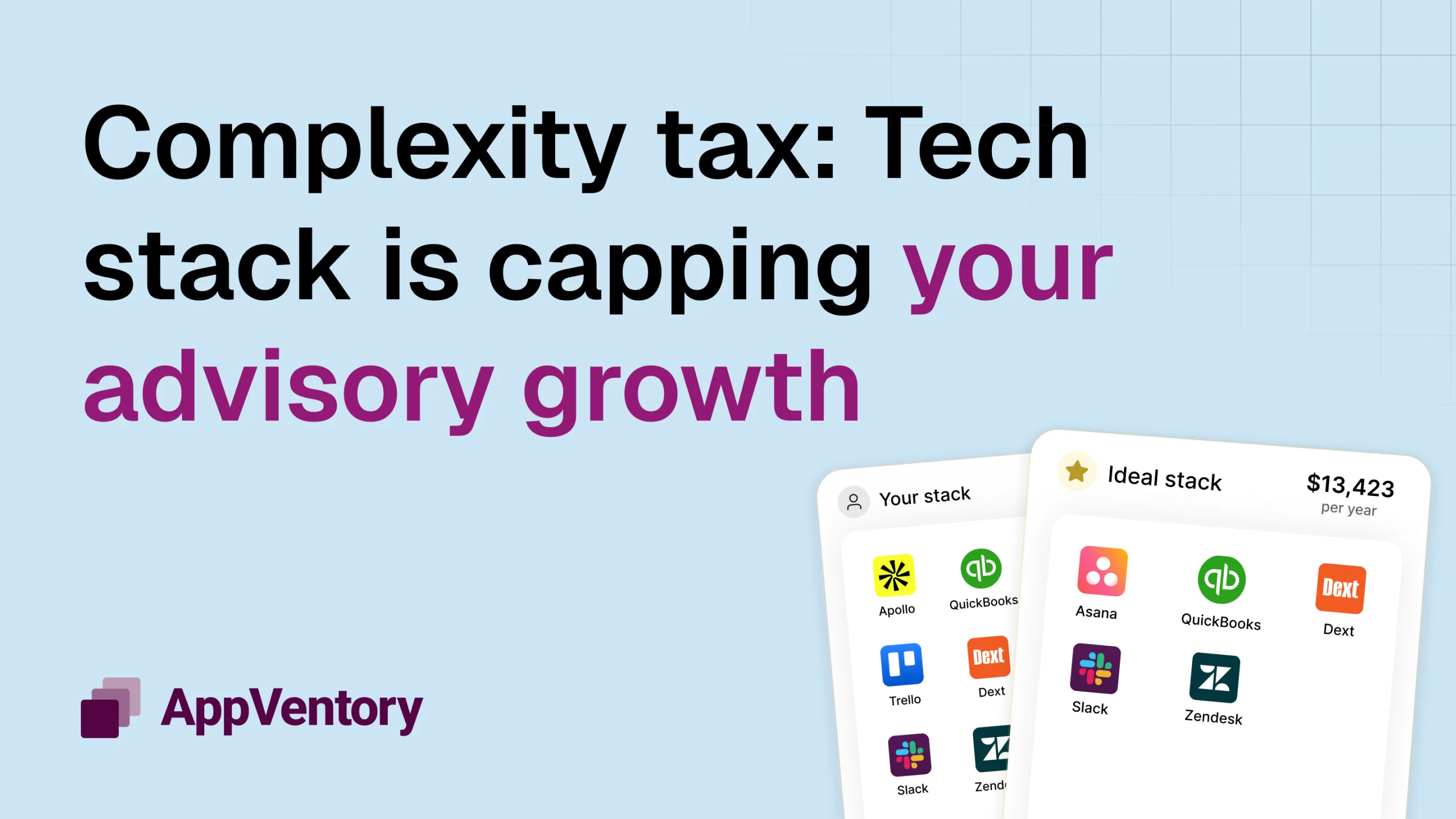
In other words, the thing holding your firm back from its most profitable work is the grunt work of moving numbers between disconnected tools. Call it the complexity tax — and most firms are paying it without realizing.
Your tech stack is crowded, and the work gets stuck in the seams
Firms have spent years buying software to run more efficiently. The irony is that the tools themselves have become a source of friction.
The survey found the average firm now runs 10 apps or software programs to manage its operations and clients, with 1 in 3 firms running 11 or more. But more tools hasn’t meant more integration: only 41% of firms say their stack is fully integrated. Nearly half say their setup works but stays fragmented.
That fragmentation has a price, and it’s measured in hours. Accountants report losing roughly 5 hours every week moving, re-entering, or reconciling information across tools. That’s more than half a working day gone before anyone touches actual client work.
And the spend keeps climbing. In the past year, 92% of firms invested in technology, averaging around $21,000 — up from $19,000 the year before. The stack gets bigger and more expensive, but the seams between tools stay exactly where they were.
Why this is really an advisory problem
Here’s where the complexity tax gets expensive in a way that doesn’t show up on any invoice.
Advisory is the highest-margin work a firm can do — clients pay for judgement and outcomes, not hours. But advisory needs capacity, and capacity is exactly what tool sprawl consumes. When asked directly what holds them back from more proactive advisory work, 30% of accountants named manual data cleanup as the top barrier. Staffing shortages came second at 24%. App overload followed at 16%.
Read those numbers together and a clear picture emerges: nearly half the barriers to advisory growth are about data friction and tool sprawl, not people. Every hour spent reconciling a client’s numbers across systems is an hour not spent advising them — and advising is the part they’ll pay a premium for.
This is why simply “doing more advisory” so often stalls. The ambition is there — 86% of accountants expect AI to expand their advisory capacity, and nearly half want their firm known for growth-focused advisory by 2030. But you can’t advise your way out of a data-entry problem. The capacity has to be freed up first.
AI helps — but only after you fix the inputs
The survey’s AI findings are striking: adoption is now table stakes, with 88% of firms using AI for client services. Three in four AI users say it delivered more value than expected.
But AI runs on data, and data trapped in disconnected systems can’t be reasoned over cleanly. The firms pulling ahead aren’t just the ones using AI — they’re the ones that have untangled their inputs first, so AI has something coherent to work with. In the survey, 77% of accountants agree the gap is widening between firms where AI is embedded in daily workflows and those using it only occasionally. That gap starts with whether the underlying data is connected or scattered.
The sequence matters. Clean, consolidated inputs first. Then AI, then higher-impact advisory on top. Firms that skip the first step are automating on a shaky foundation.
Software spend is both a symptom and an opportunity
There’s a second layer to the complexity tax, and it’s one accountants are uniquely placed to turn into revenue.
That crowded, fragmented, $21,000-a-year tech stack isn’t just the firm’s own problem — it’s every client’s problem too. Businesses are drowning in the same sprawl: overlapping subscriptions, tools bought on personal cards, seats no one uses, and now a fast-growing layer of AI tools nobody’s tracking. Most business owners have no idea what their real software footprint is.
You do — because you’re already inside their financials. That makes the firm the only advisor positioned to see the waste, quantify it, and hand it back as savings. Software and AI spend advisory turns the complexity tax into a recurring, high-margin service: a quarterly review that catches renewals before they auto-charge, flags redundant tools, and gives the client a number they can act on.
Cutting your own complexity tax
The firms that will pull ahead this decade are the ones that stop paying the complexity tax — on their own stack and on their clients’ behalf.
That starts with visibility. You can’t reclaim the 5 hours a week lost to reconciliation, or turn client software waste into an advisory line, until you can see the full picture of software and AI spend in one place.
That’s what AppVentory does. Recharge pulls a full software and AI spend footprint into a single view — flagging unused and duplicate subscriptions, tracking renewals, and surfacing the waste automatically. It cuts the manual cleanup that the survey identifies as the number one drag on advisory growth, and it packages the result as a repeatable, revenue-generating service you can sell to every client on your books.
The tax is optional. The firms that stop paying it get their capacity — and their most profitable work — back. Talk to us today to learn more.
Source: Intuit, 2026 Accountant Technology Survey, Firm of the Future, June 2026 (n=725 US accounting and bookkeeping professionals).