
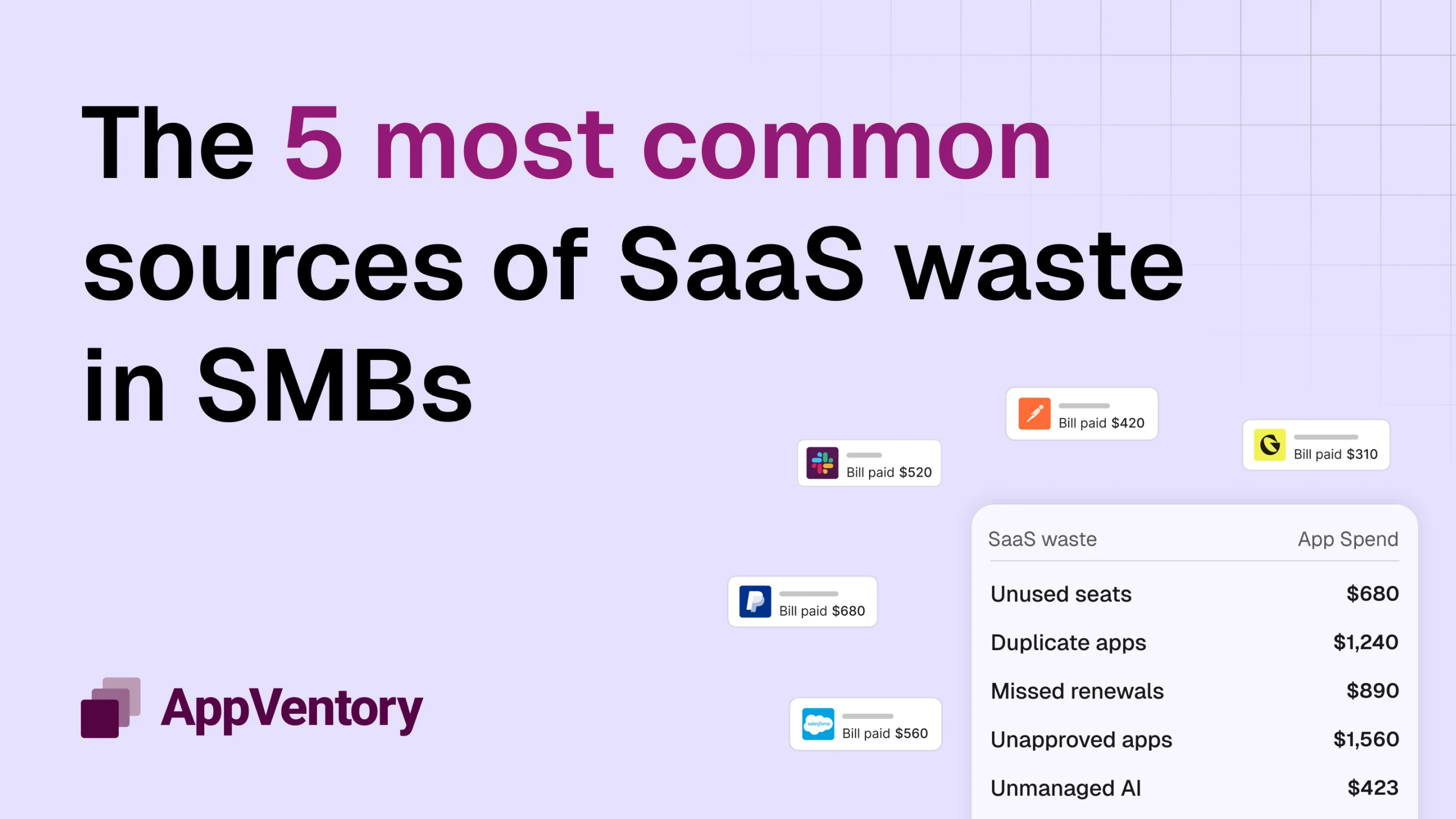
Most SMBs don’t have a software waste problem so much as a software visibility problem. Nobody’s stealing anything; the money just leaks out through the same five sources of SaaS waste, quarter after quarter, because no single person owns the full picture of what the company’s actually paying for. Once you know where to look, all five are easy to spot — and cheaper to fix than most teams assume.
The five sources of SaaS waste in every SMB stack
1. Seats nobody’s using
The most common source, and the easiest to miss. A team of twelve gets forty licenses because that’s what the plan tier required, or because headcount used to be bigger and nobody downgraded when it shrank. The invoice looks the same every month, so nothing about it signals a problem — you have to look at actual login activity to see that half those seats haven’t been touched in months. Without usage data, an idle seat is invisible; it’s just another line on a bill that always looks roughly the same. Multiply that across a handful of tools and the idle-seat total can rival the cost of the tools people actually use.
2. Two tools doing the same job
Marketing picks a project management tool. Engineering picks a different one, because nobody checked what marketing was already using. Multiply that across departments and a company of fifty people can end up paying for three overlapping versions of the same category — video conferencing, file storage, design tools — because procurement happened team by team instead of company-wide. Each subscription is small enough on its own to avoid scrutiny; it’s only visible when you can see everything at once.
3. Renewals nobody reviewed
Most contracts auto-renew by default, and most SMBs don’t have a system that flags a renewal date before the charge hits. A tool bought two years ago for a project that’s long since wrapped keeps renewing annually, at whatever price the vendor set, because reviewing it would mean someone remembering it exists. The waste isn’t the tool — it’s the year of runway between “this stopped mattering” and “someone finally noticed.” By the time it’s caught, the notice window to negotiate or cancel has usually already closed.
4. Subscriptions nobody approved
Any employee with a company card can start a subscription in an afternoon — no procurement ticket, no finance sign-off, no line in a master spend sheet. This is shadow IT, and in a small business it grows fast precisely because there’s no formal buying process to route around. The tools themselves are often useful. The problem is that nobody outside the person who signed up knows they exist, so they never get reviewed, never get negotiated, and never get cancelled when they stop being useful.
5. AI subscriptions piling up unmanaged
This is the newest source, and it’s growing the fastest. A marketing lead trials one AI writing tool, an engineer signs up for a coding assistant, someone in ops adds a third — each on a personal trial that quietly converts to a paid seat. Unlike traditional software, AI tools multiply per person rather than per team, so the sprawl outpaces anything a finance team is used to tracking. Most SMBs don’t yet have a category for “AI spend” separate from “software spend,” which means it’s the least likely of the five to get caught.
Why these five keep recurring
None of these sources are unique to any one company — they show up in almost every SMB stack, because they’re symptoms of the same root cause: software and AI spend grew faster than any one person could watch by hand. A finance team built to review a dozen vendor contracts a year wasn’t built to review the hundred-plus tools a modern SMB actually runs, so most of that spend goes unreviewed by default, not by neglect.
Catching all five usually requires the same thing: a live map of every tool in use, who’s actually using it, and when its contract renews — refreshed automatically rather than rebuilt from memory every time someone asks. Platforms like AppVentory are built around exactly that gap, discovering the full stack from day one and scoring real usage down to the seat, so waste shows up as a specific finding instead of a vague sense that something’s off.
None of the five require a big project to start catching. Pulling a full list of active subscriptions and checking last-login dates against seat counts will surface the first two on this list within an afternoon — the renewal and shadow-spend sources take longer to see clearly, since they depend on knowing what’s coming due and who signed up for what, which is exactly the part that’s hardest to track by hand.