The problem: renewals happen to you, not with you
Most companies don’t manage renewals. They discover them. A charge lands on the card, someone in finance asks “did we mean to keep this?”, and the answer is usually a shrug. By then the window to negotiate, downgrade, or walk away has already closed — most vendor contracts auto-renew unless you cancel inside a fixed notice period, and that period has usually passed before anyone thought to look.
This isn’t a discipline problem. It’s a visibility problem. Contract start dates, notice periods, and owners live scattered across inboxes, shared drives, and whichever procurement person set up the tool eighteen months ago. And manual tracking breaks on people, not just tools: the person who negotiated the contract and knows its terms is often the same person you’re relying on to flag it 60 days out — and they’ve since changed roles, or left. The knowledge walks out the door with them, and the renewal keeps ticking on autopilot.
The reason this got worse isn’t carelessness — it’s math. Ten years ago, a company ran maybe a dozen pieces of software, procured through one or two people. Today, any team with a credit card can spin up a new tool in an afternoon — no procurement ticket, no finance sign-off, no line in a master contract sheet. Every one of those tools comes with its own contract, its own renewal date, its own auto-charge default. Multiply that across departments and you get a renewal calendar that would need to live in dozens of places at once — which, practically speaking, means it lives nowhere. A spreadsheet someone built in 2023 doesn’t know about the three tools marketing added last quarter, or that IT switched a plan tier in June.
The cost isn’t just the wasted dollars on a tool nobody uses anymore. It’s the leverage you lose. A renewal you catch 60 days out is a negotiation. A renewal you catch after the charge is a sunk cost.
What good looks like: one system, catching every date automatically
A working renewal calendar isn’t a spreadsheet someone maintains by hand. It’s a live system that already knows every contract exists, because it discovered them — not because someone remembered to log them.
That starts with discovery: every app, license, and subscription across the business, mapped from day one, not just the ones procurement signed off on. From there, the calendar isn’t something you build once and hope stays current — it’s something that updates itself as tools get added, seats change, and plans shift.
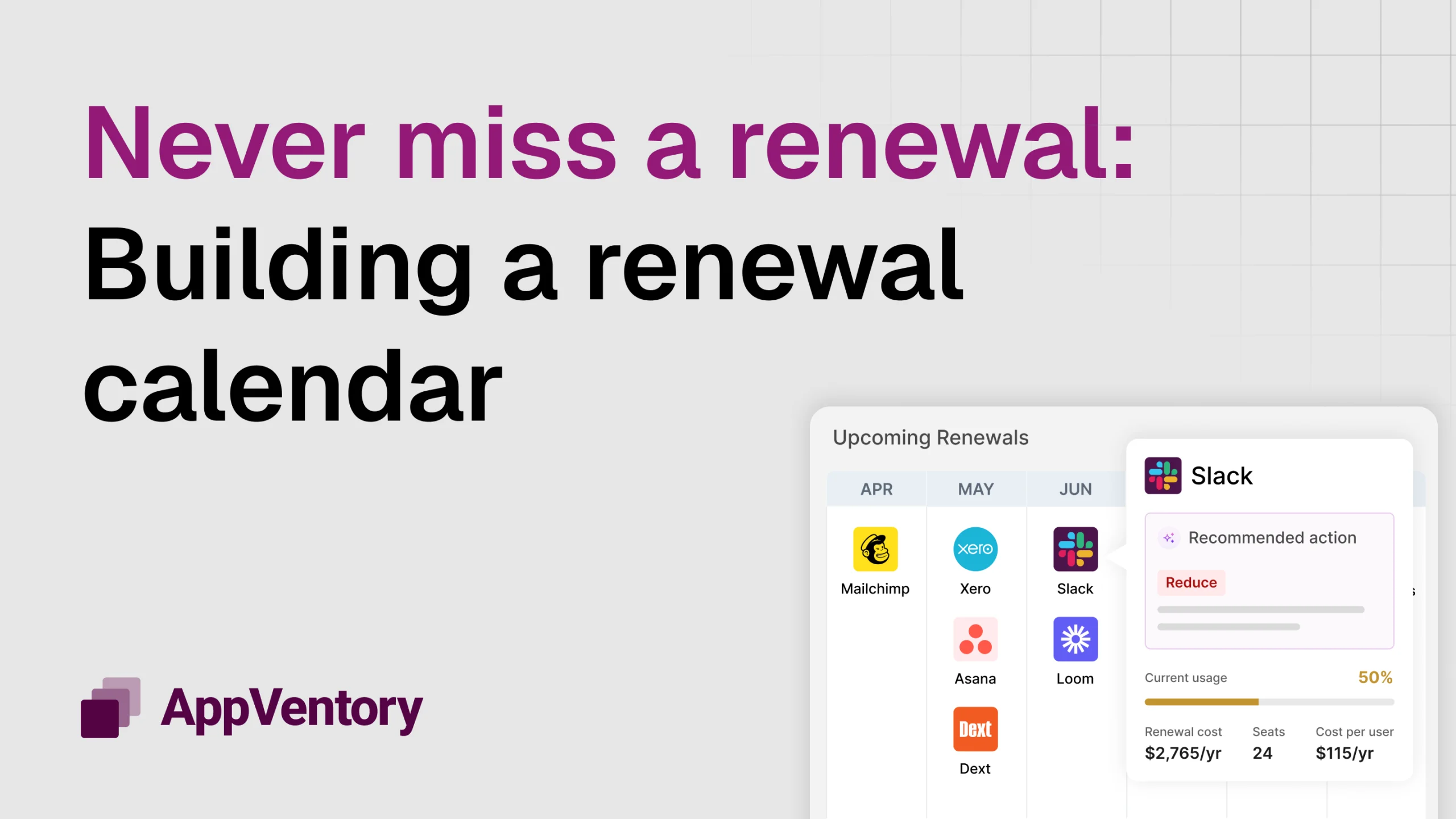
The part that actually saves you money is the timing. Alerts at 90, 60, and 30 days before a renewal give you three real windows instead of one panicked scramble the week the charge is due. Ninety days out, you’re checking whether the tool is even being used. Sixty days out, you’re deciding whether to renegotiate. Thirty days out, you’re making the call.
This is where AppVentory’s approach differs from a shared calendar or a reminder someone sets manually: every renewal comes with the usage data attached, so the decision isn’t “do we remember what this tool does” — it’s “here’s who’s actually using it, and here’s what we’re paying for seats that aren’t.” You approve or dismiss the recommendation; the agent does the work of surfacing it in time to act.
Concrete steps to build your renewal calendar
You don’t need a platform to start tightening this up today. The single highest-leverage move:
Log the real notice period, not the renewal date. A 30-day notice window on a date you flag with 15 days left is a missed window. This is where most renewal calendars quietly fail.
Then build around it:
Pull every active contract into one list. Don’t rely on memory — check your accounting software’s vendor list, not just the tools finance knows about.
Assign an owner to every contract, not just the ones over a certain dollar threshold. Small subscriptions add up, and they’re the ones most likely to get forgotten.
Set alerts at 90/60/30 days, not just “renewal month.” One reminder isn’t enough time to negotiate anything.
Review usage before every renewal decision — a tool renewing at full price with three of forty seats active isn’t a renewal, it’s a downgrade waiting to happen.
The payoff
A renewal calendar that actually works turns every contract from a surprise into a decision. Instead of a charge landing and finance asking whether you meant to keep it, you walk into every renewal already knowing who’s using the tool, what you’re paying for seats that sit idle, and how many days you have to act. That’s what managing renewals with your business looks like — not discovering them after the fact.