AI in accounting has crossed the tipping point. The question for firms is no longer whether to use it — it’s why so many firms adopting AI still aren’t seeing the payoff they expected.
The adoption numbers are settled. According to Intuit’s 2026 Accountant Technology Survey of 725 US accounting professionals, 88% of firms now use AI for client services and 86% for firm operations. Among those users, three in four say AI has delivered more value than they expected.
And yet the same firms report that their biggest barrier to higher-value work isn’t a lack of AI. It’s manual data cleanup. That contradiction is the real story of AI in accounting in 2026 — and understanding it is what separates the firms pulling ahead from the ones running in place.
How widely is AI used in accounting?
Broadly, and across nearly every task. The Intuit survey found 88% of firms used AI for at least one client service in the past year, with the top uses being data entry and processing, financial forecasting, and real-time insights. On the operations side, 86% used it for invoicing, client communication, or portfolio management.
Independent data tells the same story. A Stanford and MIT study published in the Journal of Accountancy examined 277 accountants across 79 firms and found that AI adoption cut the monthly close by 7.5 days and shifted 8.5% of accountants’ time from routine tasks toward analysis and advisory work.
Adoption, in other words, is no longer the interesting question. The interesting question is why the results are so uneven.
Why isn’t AI adoption translating into advantage?
Because saving time and keeping that time are two different things.
Here’s the finding most “AI in accounting” articles skip. Research from Workday found that almost 40% of the time saved through AI is offset by time spent correcting, clarifying, or rewriting low-quality outputs. For every ten hours of efficiency gained, nearly four are lost to rework.
The reason is almost always the same: AI runs on data, and when that data is scattered across disconnected tools, the output is only as clean as the mess it was trained on. Feed AI fragmented, inconsistent inputs and it produces work that needs checking, correcting, and reconciling — which quietly eats the very hours it was supposed to save.
This is why adoption alone doesn’t create advantage. The firms seeing real returns aren’t just the ones using AI. They’re the ones that fixed their inputs first.
The data problem underneath the AI problem
The Intuit survey quantifies just how messy those inputs are. The average firm now runs 10 apps or software programs, with one in three running 11 or more. Only 41% say their stack is fully integrated. As a result, accountants lose roughly 5 hours every week simply moving, re-entering, and reconciling information across tools.
That’s the foundation AI is being asked to run on — and it explains the rework. When asked directly what holds them back from more proactive advisory work, 30% of accountants named manual data cleanup as the single biggest barrier, ahead of staffing shortages and app overload.
So the sequence that actually works looks like this: connect and clean the data first, then layer AI on top, then redirect the freed-up capacity into advisory. Firms that skip the first step are automating on a shaky foundation — and paying for it in rework.
What does AI actually free accountants up to do?
When the sequence works, the payoff is advisory — the highest-margin work a firm can do.
The pattern is consistent across the research. In the Intuit survey, 86% of accountants expect AI to expand their advisory capacity in the next year. Separately, industry analyses show firms redirecting AI-freed hours into cash flow forecasting, tax strategy, and business planning — advisory work that commands materially higher rates than compliance.
But that shift only happens if the capacity is genuinely freed, not silently reabsorbed by rework. Clean inputs are what make the difference between AI that looks productive and AI that actually is.
Where does the software itself fit in?
There’s a second, often-overlooked dimension to AI in accounting: the AI tools themselves are now part of the sprawl.
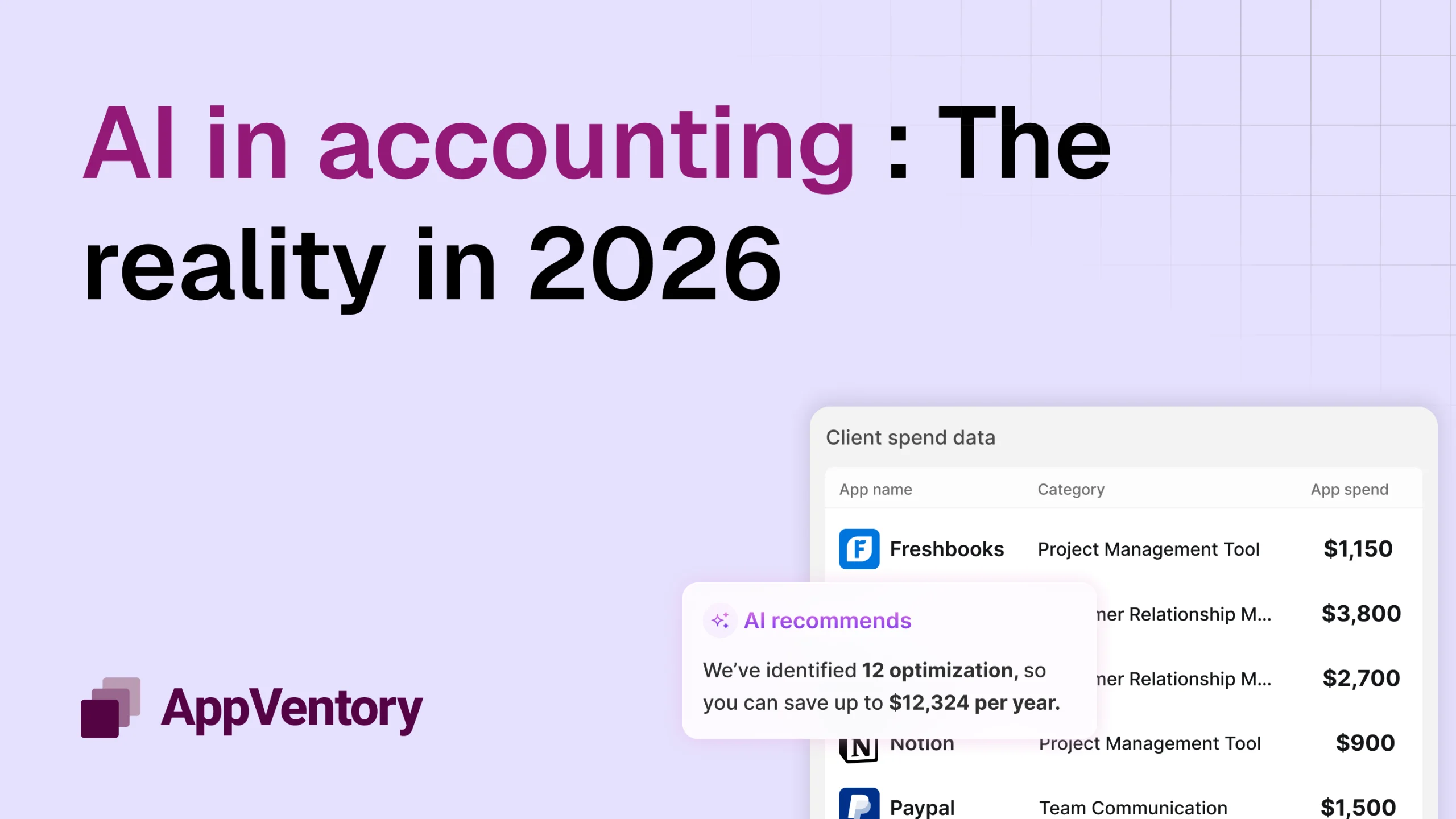
Every firm — and every client — is accumulating a fast-growing layer of AI subscriptions, often bought ad hoc, sometimes on personal cards, rarely tracked in one place. That’s new spend, new renewals, and new waste layered on top of an already crowded software stack. Most business owners have no idea what their real software and AI footprint actually is.
Accountants are uniquely placed to solve this — because they’re already inside the financials. Turning that visibility into a recurring software-and-AI spend review is one of the clearest advisory opportunities the AI era has created: catch renewals before they auto-charge, flag redundant tools, and hand the client a number they can act on.
The bottom line on AI in accounting in 2026
Adoption is done. Nearly every firm is using AI. The competitive gap now runs between firms that treat AI as a switch to flip and firms that treat it as the top layer of a system that has to be clean underneath.
That system starts with visibility — one connected view of a firm’s (and its clients’) software and AI spend, so the inputs AI depends on are consolidated rather than scattered.
That’s what AppVentory provides. Recharge pulls a full software and AI spend footprint into a single view — flagging unused and duplicate subscriptions, tracking renewals, and cutting the manual cleanup that the data shows is the number one drag on advisory growth. It’s the groundwork that makes AI adoption actually pay off, and it doubles as a repeatable, revenue-generating service you can offer every client on your books.
Want to learn more? Book a call with us today.
Sources: Intuit, 2026 Accountant Technology Survey, Firm of the Future, June 2026 (n=725). Additional data: Workday (via Accounting Today, Jan 2026); Stanford/MIT study via Journal of Accountancy (2025).